Conceptual Framework: Agent Based Factory
1. The DNA of a Factory
Every factory or company, before having a single employee or machine, exists as a set of foundational decisions that give it identity. These decisions form a causal chain where each level enables the next:
The mission answers "why do we exist?", and it is deliberately generic because it defines purpose without tying it to a specific product. From the mission comes the vision, which projects where we want to be within a time horizon. From the vision comes the strategy, which breaks down that desired future into measurable objectives. And from the strategy come the functional areas: each area exists because there is a strategic objective that someone must fulfill.
In your Agent Based Factory, this chain is identical: the factory needs a mission, a vision, and a strategy before a single agent exists. Agents are the equivalent of employees, not of purpose.
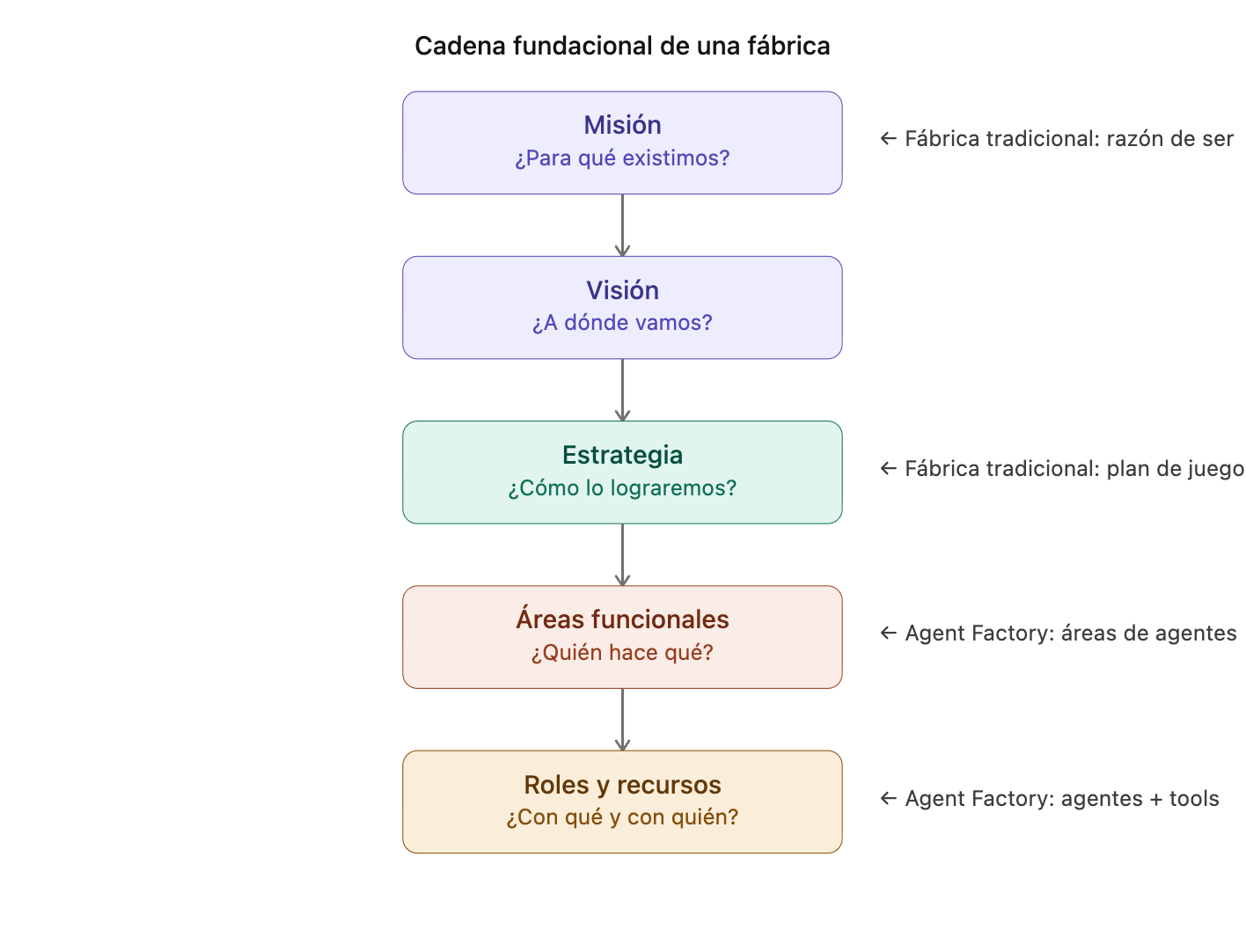
The key is that the first two layers (mission and vision) are purely declarative: they don't define technology, they don't define agents, they don't define tools. This is what makes your factory generic. Only when you reach the "roles and resources" layer do you decide whether that role is filled by a human, an agent, or a combination of both.
2. Common Organizational Structures
Once you have the DNA, you need to decide how to organize the areas among themselves. In industry, there are four dominant structures, and each has direct implications for how you would organize an agent factory:
The functional structure groups by specialization (production, sales, finance). It's the most common in traditional factories. In an Agent Factory, this would mean having "departments" of agents specialized in one type of task.
The divisional structure groups by product, market, or region. Each division is nearly autonomous. In your case, each division would be an independent "production line" with its own agents.
The matrix structure combines both: agents belong to a functional area but work on cross-cutting projects. It's the most complex but the most flexible.
The flat structure minimizes hierarchies. Few levels of command, direct communication. Ideal for small or agile agent factories.
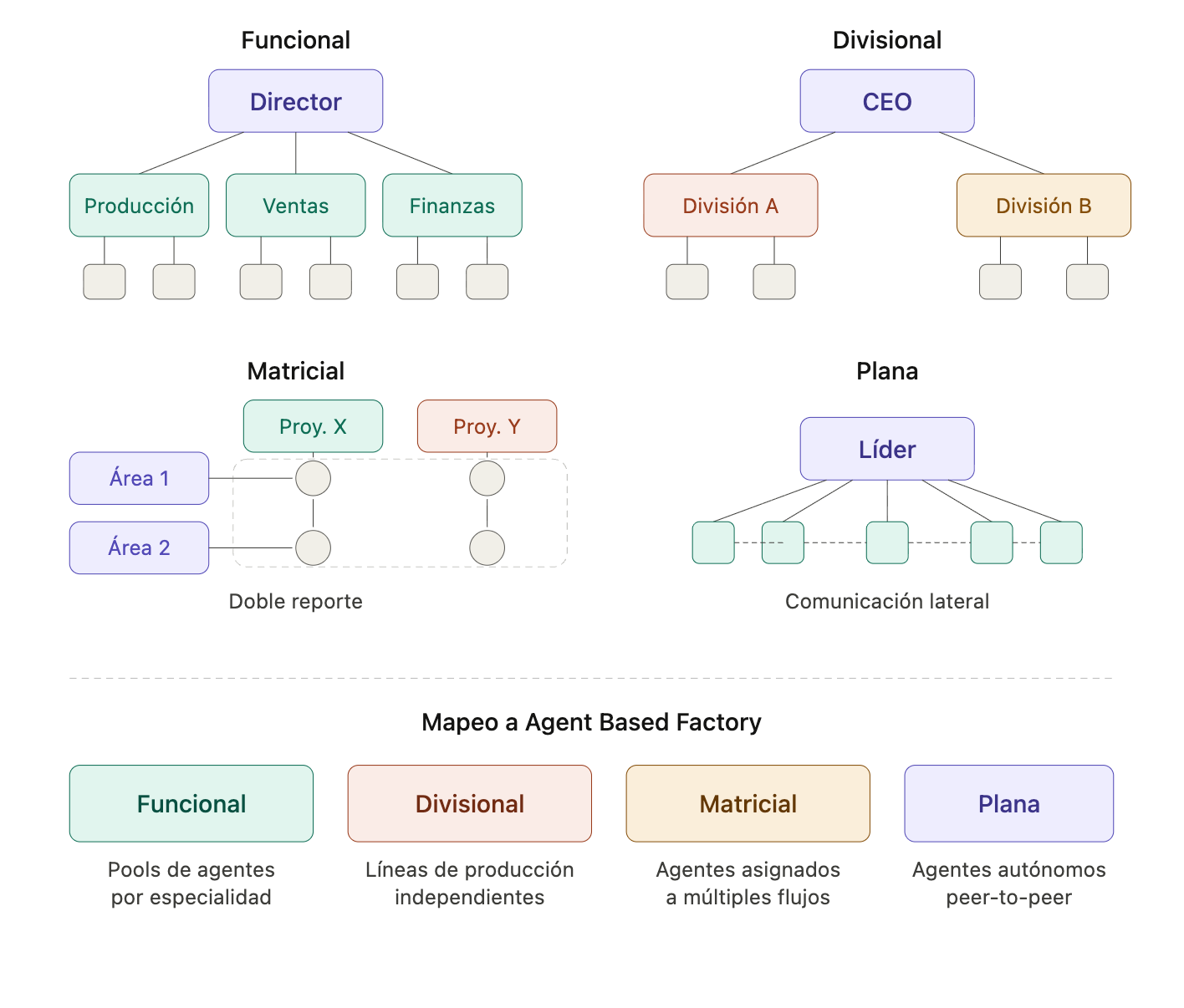
For your Agent Based Factory, the initial recommendation is to start with a functional structure (the simplest to implement) with the ability to evolve toward a matrix when complexity requires it. The flat structure is tempting in agent systems, but without hierarchy you lose the coordination and supervision capacity that makes a factory operate predictably.
3. How Areas Are Defined
An area is not just a name on an org chart. Each area of a factory is defined through five formal elements:
The area's purpose is a short statement of why it exists, derived directly from the strategy. If the strategy says "maximize operational efficiency," then there is an operations area whose purpose is exactly that.
The scope defines what falls within its responsibility and what doesn't. This is critical in an Agent Factory because it prevents agents from one area from invading another's responsibilities. It's the equivalent of defining domain boundaries.
The inputs and outputs formalize what the area receives from other areas and what it delivers. In a physical factory, production receives raw materials from procurement and delivers finished product to logistics. In an Agent Factory, this translates directly into the interface contracts between groups of agents.
The internal processes are the transformations that the area applies to its inputs to produce its outputs. These processes are what will eventually become your agents' workflows.
And the indicators are the metrics that measure whether the area is fulfilling its purpose. Each area has its own KPIs, and these aggregate upward to form the indicators of the complete factory.
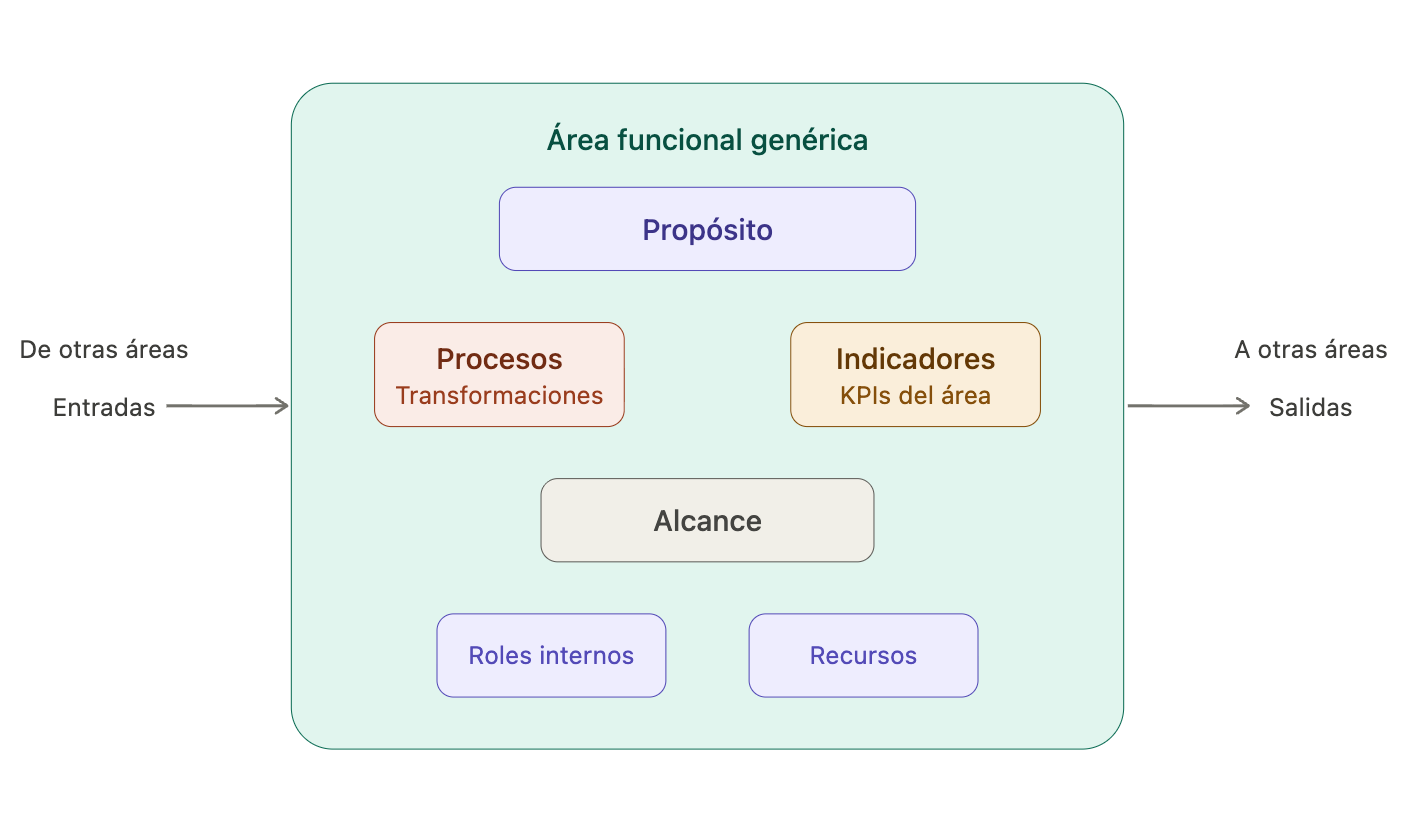
In your Agent Based Factory, when you eventually implement an area, each of these five elements translates into configuration: the purpose becomes the agent system's context, the inputs/outputs become the interfaces (APIs, messages, events), the processes become the workflows, and the indicators become the metrics you monitor to know if the area is working.
4. Roles, Hierarchy, and Who Leads
In a traditional factory, roles are organized into three fundamental levels:
The strategic level (C-suite, general directors) sets the direction. They don't execute operational tasks. They are measured by high-level indicators like profitability, market share, and growth. In an Agent Factory, this level could be an "orchestrator agent" or simply the static configuration that governs the entire factory.
The tactical level (area managers, department heads) translates strategy into execution plans. They decide how work is distributed within their area, what priorities each team has, and when to escalate a problem upward. They are measured by operational efficiency, schedule compliance, and delivery quality. In your factory, these would be supervisor agents or area coordinators.
The operational level (operators, analysts, executors) are the ones who do the work. They follow instructions, execute processes, and report results. They are measured by individual productivity, error rate, and cycle time. These are your execution agents.
What makes this hierarchy work is not authority but the flow of information: strategy flows down as directives, and operational results flow up as reports and metrics. This bidirectional flow is what allows the factory to self-correct.
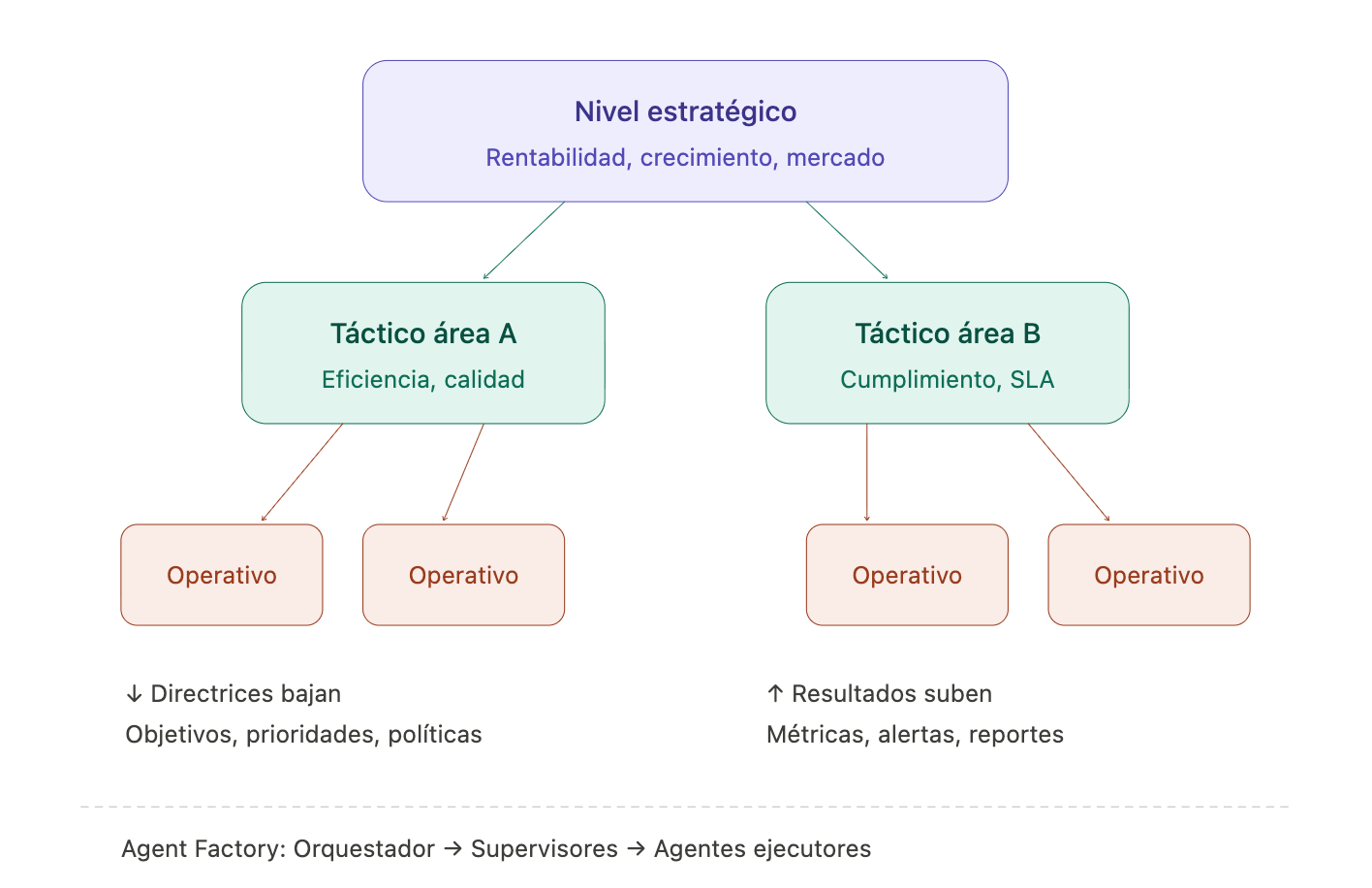
Each role in the factory is formally defined with: a title, an area it belongs to, a superior it reports to, the required competencies, and the indicators under which it is evaluated. In your Agent Factory, this becomes each agent's "profile": its name, its group, its coordinator, its capabilities (tools), and its performance metrics.
5. Communication Between Areas
This is one of the most critical aspects and where most factories fail, both traditional and digital. Communication between areas is neither informal nor improvised: it follows protocols defined through specific mechanisms.
There are three types of communication between areas:
Vertical communication flows between hierarchical levels. Directives and decisions go down, reports and escalations go up. Typical channels include committee meetings, dashboards, and periodic reports.
Horizontal communication flows between areas at the same level. It's the most frequent and has the greatest impact on operational speed. It occurs when one area needs something from another to continue its work. Typical channels include work orders, formal requests, and shared systems.
Cross-cutting communication crosses both levels and areas. It occurs in special projects, crises, or initiatives that involve the entire factory. Channels include cross-functional meetings, task forces, and general communications.
For your Agent Factory, each type of communication maps to a different technical pattern:
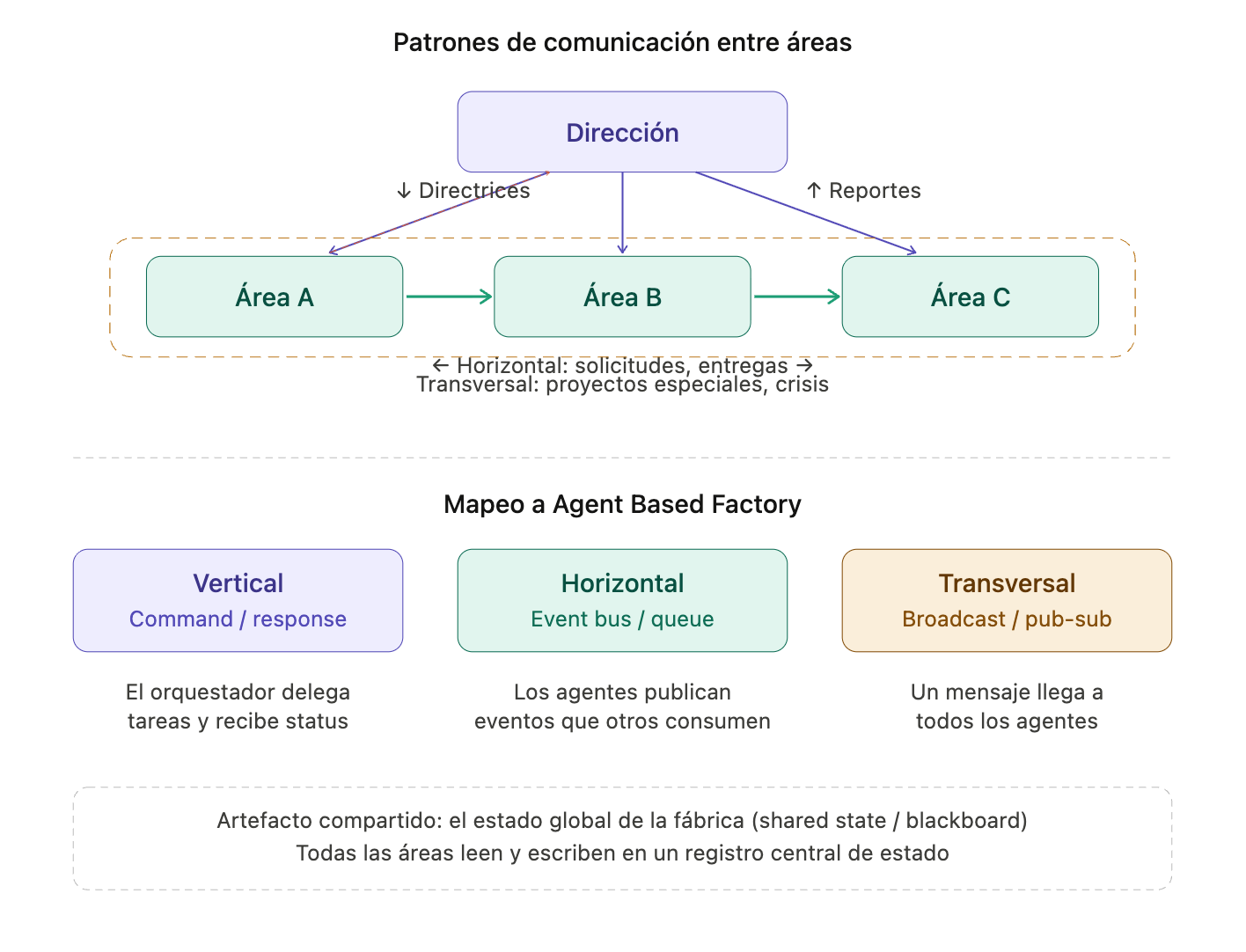
There is an additional concept that is fundamental: the shared state or blackboard. In a physical factory, this is the production board, the ERP system, or the visible shop floor. It's a place where any area can see the general state of the factory. In your Agent Factory, this is implemented as a global state that all agents have read access to, and only certain agents have write access to based on their permissions.
6. Management Artifacts: How to Know if the Factory Is Doing Well
Factories don't operate blindly. There are formal artifacts that allow you to evaluate the health of operations. These are organized in a hierarchy that reflects the levels of command:
At the strategic level are the high-level artifacts: the balanced scorecard (which balances financial, customer, process, and learning perspectives), OKRs (objectives and key results), the P&L (profit and loss statement), and the strategic dashboard that the board reviews periodically.
At the tactical level are the operational dashboards for each area: throughput (units produced per period), lead time (time from order entry to product delivery), defect rate, capacity utilization, and backlog.
At the operational level are the individual metrics: tasks completed, time per task, error rate, and availability.
The magic lies in aggregation: operational metrics aggregate to form tactical ones, and tactical ones aggregate to form strategic ones. If an operational agent has a 15% error rate, that affects the area's quality indicator, which in turn affects the strategic scorecard.
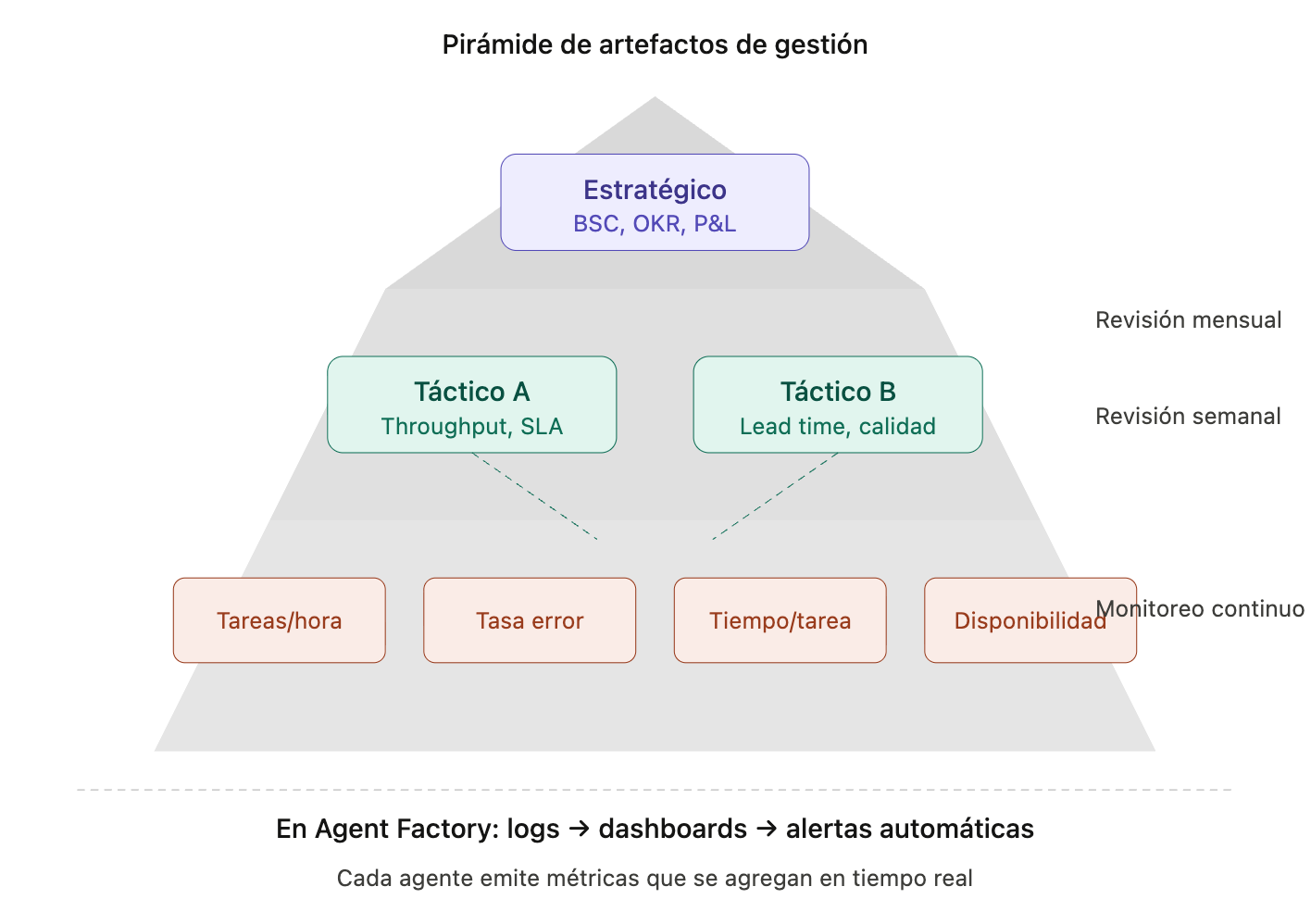
In your Agent Factory, the enormous advantage is that these metrics can be captured in real time. Each agent can emit telemetry from its execution (duration, result, errors), and an observability system can aggregate those metrics automatically. You don't need to wait for the monthly report: the state of the factory is visible at every moment.
7. The Complete Conceptual Model: Agent Based Factory
Now let's put it all together. Your Agent Based Factory is a structure that inherits the organization of a traditional factory but replaces human resources with AI agents. The model has clearly separated layers, and most importantly, the configuration layer (mission, structure, areas) is defined before and separately from the implementation layer (agents, prompts, tools).
This five-layer model is the essence of your Agent Based Factory. Several design principles emerge from everything we've covered:
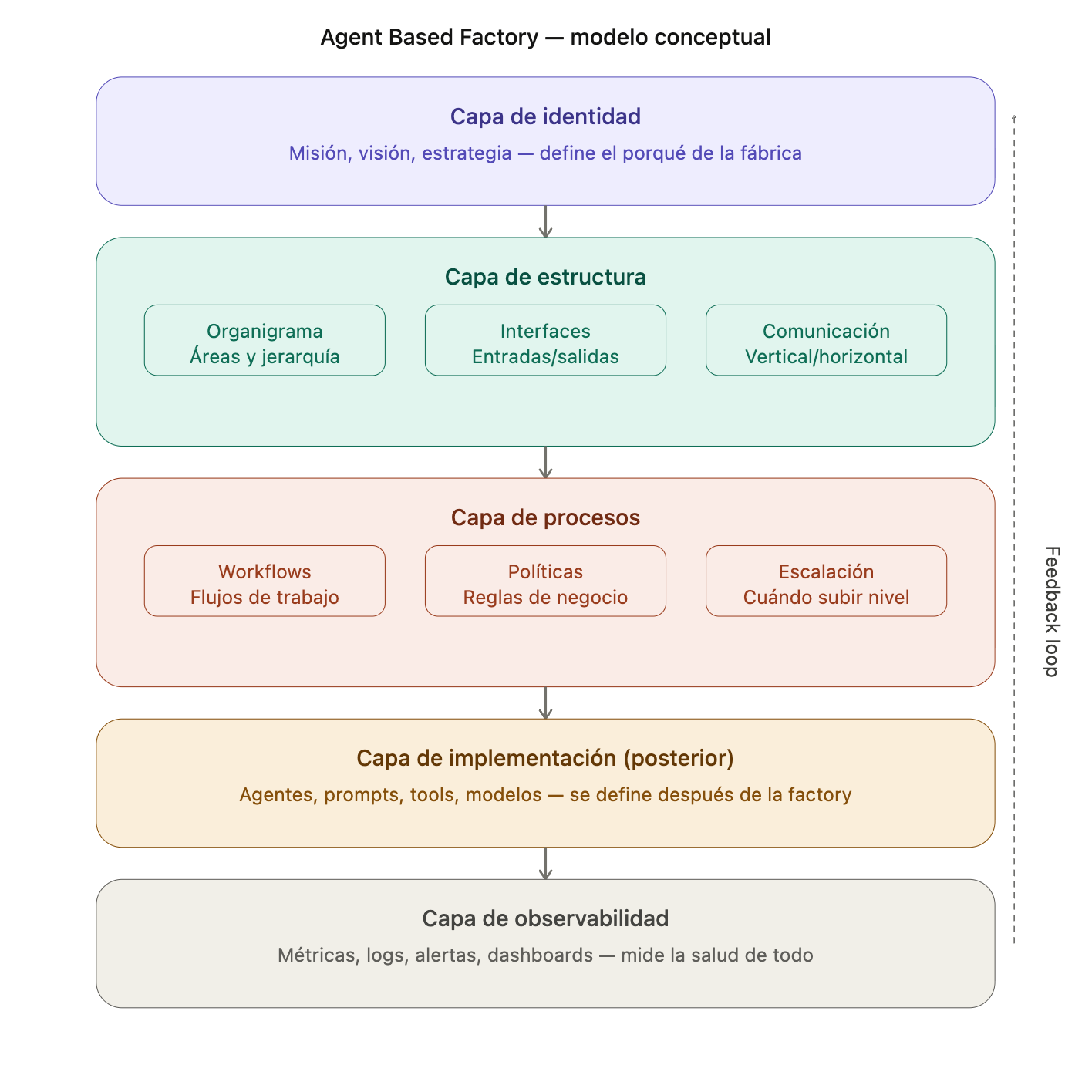
Separation of layers: each layer can be designed and modified independently. You can change the organizational structure without touching the agents, or change the agents without touching the strategy. This is what makes the factory generic.
Configuration over code: the first three layers (identity, structure, processes) are pure declarative configuration. They don't require programming anything. They are documents, diagrams, definitions. Only the fourth layer (implementation) touches technology.
Observability as a first-class citizen: the observability layer is not a "nice to have." It's what closes the feedback cycle and allows the factory to self-correct. Without it, you're operating blind.
The feedback loop: the lateral arrow that rises from observability to identity represents the most important cycle of any company. Operational data informs strategic decisions, which in turn modify the structure, which modifies the processes, which reconfigures the agents.